Category: Contact Improvisation

  • Remembering Nancy Stark Smith

    Remembering Nancy Stark Smith

    I’ve been wondering just what the heck I could write about Nancy that hasn’t already been said, especially as others (whom I admire so) have written of their deep and multi-decade relationship with her. I took a little walk around the neighborhood so I could think think think, when the Chögyam Trungpa saying that Nancy loved to share came to mind: “Replace ambition with curiosity.” So, I stopped thinking as much as I could, continued on with my walk, and took some phone snapshots of a streetlamp behind some tree branches instead. In a similar vein, I will just write what comes to mind, letting my curiosity lead me rather than ambitioning to be someone I am not.

    When I heard of Nancy’s passing, what I experienced feels difficult to describe with words. I could (and did) say that I felt numb, but that really wasn’t it. After receiving the news, I walked across the street to the park, journal in hand, to see if any words would come. A few did, so I wrote them down. I don’t remember them right now, though. I do remember that I soon found myself just lying on the grass, feeling the weight of my body—my mass, atop this large sphere of the earth. What was it that Nancy said? Something like, the earth is the biggest dancer out there, so might as well become friends with it? I forget. It doesn’t really matter right now, and it didn’t then either. Over the span of a few minutes, I sensed a shift. From clock time to body time. Letting my body guide the whole of me, without words. Just, simply, bonding with the earth.
    Dec 2012: Glimpse retreat. Santa Cruz mountains, CADec 2012: Glimpse retreat. Santa Cruz mountains, CA

    So much of Nancy’s vocabulary—her literal words and turn of phrases—has seeped into my own. After my first workshop with her at Earthdance, I helped her clean her room in the dorm and asked her what she thought I might be able to work on when I went back. She took a moment from her packing to think—that thoughtful pause of hers—and gave me three words for me to think about: Availability, Permeability, and Mutability. I have to say that these three words have stuck with me in so many ways, and I am still reflecting upon them.

    Her ability to describe the ephemeral and the experiential felt inspiring—as though she had developed a conduit between the somatic and the cognitive. There are plenty of folks who wax poetic about bodily experiences that feel fluffy and leave me hungry, or those whose kinesthetic descriptions feel abstract and kind of crunchy between my teeth. Nancy’s articulations felt, somehow, refreshing yet substantial. Like, simple—although, certainly not easy. Kind of like how some people can make miso soup out of the ingredients they just had in their fridge and make it warm the depths of my heart.
    Mar 2011: Nancy loved this image, taken at Earthdance. Plainfield, MA

    Consideration. Deliberation. Articulation. Her reading glasses, usually with colorful arms, would seem perched atop her head when she spoke about something. She would slip them back on to write a few words or to consult a few notes. I remember evenings during Glimpse retreats in a living room full of dancers, tired from the day’s research and full from a hearty communal meal, engaging in conversation of this or that aspect of the Underscore; I remember spending about three evening sessions a couple of hours each to go through a collective talk-through, and we still barely scratched the surface. While sipping red wine (usually from the Ribera del Duero region), Nancy would share the history of a certain connection, and how it reminded her of falling leaves or a group of fish or a certain dancer or a painting—and, then would nimbly shift into talking about Bonnie Bainbridge-Cohen’s idea of generative space, or to interrogate us about our own aesthetic responses of what excites us. How, yes, “Pow-wow” didn’t feel right anymore but that she wasn’t excited about “Opening Circle” (seemed too generic) and was toying with “Assembly” (although it sometimes reminded her of school assemblies)—while some of us in the room felt frustrated at having to wage the same argument for years (if not much, much longer for some folx).

    Within that is a lesson of sorts for me, though. Coming from a hierarchal culture where those in power, especially elders, are not to be questioned, that Nancy was open to receive such arguments and deliberate (albeit at her own pace at times) feels really important to me. That I could formulate my weight, and push into her. That she was, indeed, available, permeable, and mutable herself allowed me to come as I was. (Her words echo in my being.) Even if I failed to show up for contemplative dance practice at 7:00am, I felt no reprimand. Of course. And, to be able to perform with her and celebrate that her handwritten Underscore posters hung by the studio entrance with “Assembly” written by her, for the very very first time.

    A couple of other quick vignettes also come to mind. During some projects, Mike would join us at some point. It could have just been my imagination, but I swear she would do little pitter-patters on her feet the closer the day when Mike would arrive. I don’t know how else to describe it—as though her own body felt lighter, or had more ping-pong balls jumping around inside of her? I think she was giddy. Really.

    And, on the drive from Santa Fe to Boulder, we stopped briefly at a tiny town. She said she and Mike had driven the same road before (with Mike’s daughter, I think) and she wanted to get a map—a real, physical, paper map—so she could know the names of the Sangre de Cristo mountain peaks that we were passing. As we went back to my car, she paused and took a photo of a building across the street. I don’t know exactly what she saw and I wish I knew. At the same time, the mystery keeps me taking pictures and taking mental compositional snapshots when I don’t have a camera handy.

    May, 2009: Nancy Stark Smith and Mike Vargas walking with rocks atop their heads. Moab, UT

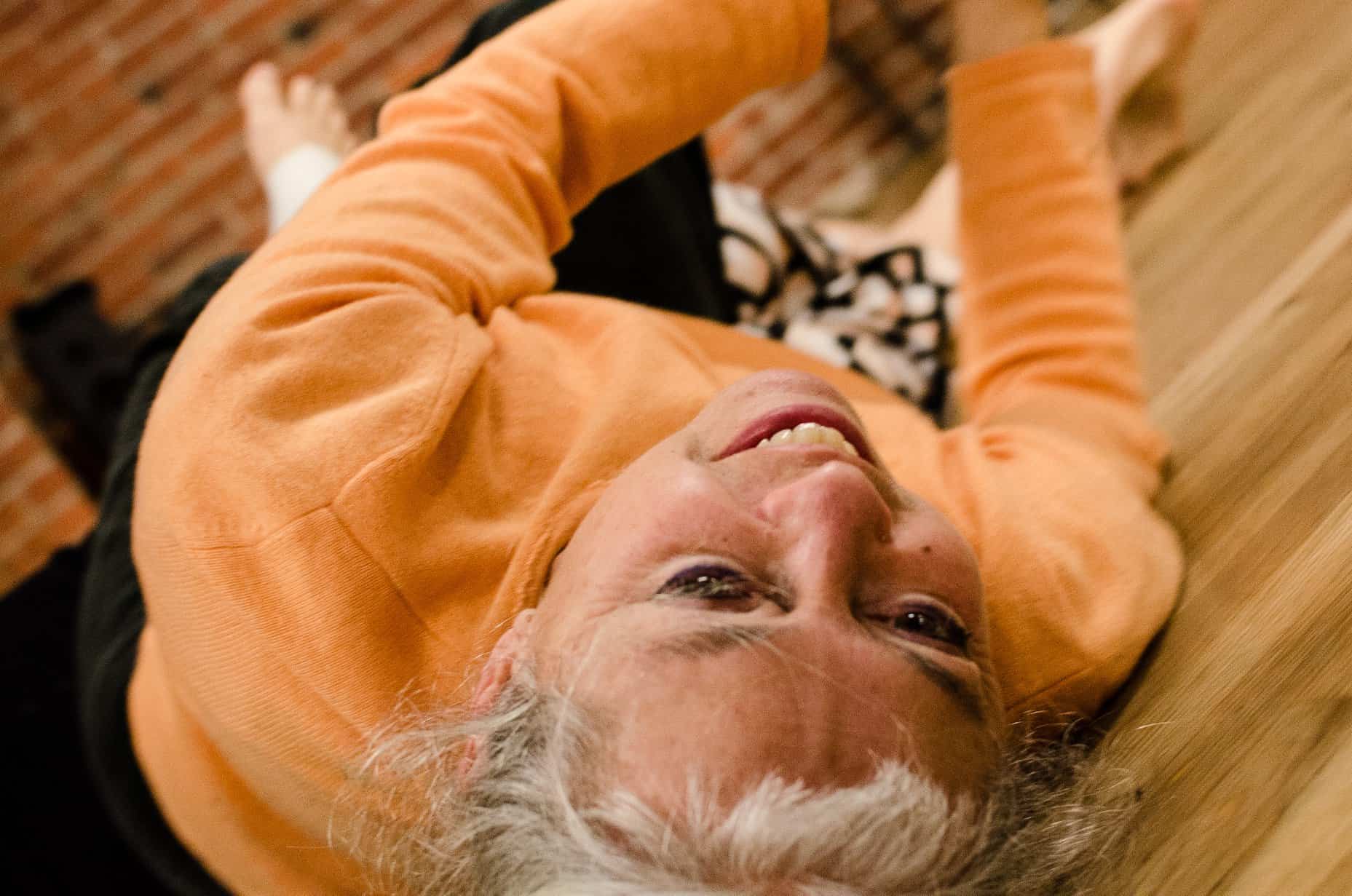
    And, here we are, in a world changed through a global pandemic. In which grieving occurs through Zoom. Over texts and phone calls. Through seeing her smiling in her orange-and-white shirt and her braid cascading in front of her left shoulder, over and over and over and over again on Facebook. When touch is to be avoided. When the best we can hope for, really, is to be alone together. Amidst all of this sadness is, indeed, deep gratitude. To encounter a human being with such depth of investigation—of body, mind, and spirit; with such rigor in introspection and expression; with infinite interest for the unknown, but with few attachments to the outcomes. That I am now practicing as a somatic psychotherapist, I owe her sincere appreciation—not only in her writing me (in the span of 48 hours) a letter of recommendation for grad school, but through years of support for my own improvisational inquiry. That I can sit with clients through uncertainties and “gaps,” that I can remain open to possibilities outside of my own repertoire, that I can sense my own interoceptive state, that I can trust my kinesthetic instincts to explore, that I can navigate relational space across differences, that I can listen with my ears and the rest of my body—there is so much to be grateful for tonight.
    So, to come full circle and to end with what so many people have said.

    Thank you, Nancy. I love you. Thank you.
  • Arriving Socioculturally

    Arriving Socioculturally

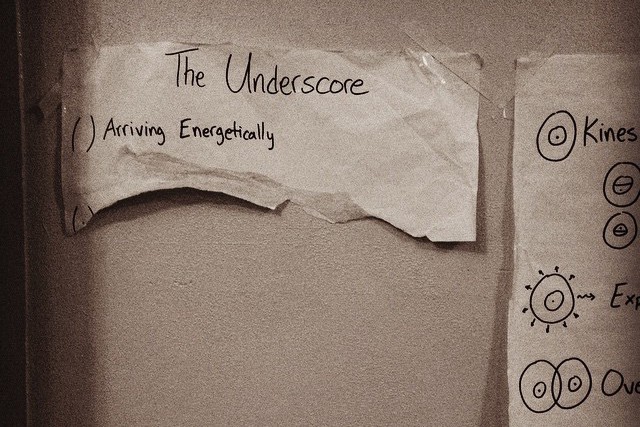
    At a recent Underscore, I started thinking about the notion of arriving. Nancy Stark Smith described the phase of Arriving Energetically as, “Bringing your attention, your presence, your will, into the room. Bringing your focus into the present situation” and Arriving Physically as “Arriving into sensation. Focusing your attention on your physical sensations, the textures and locations of sensation throughout the body. […] Becoming present in your body” (Koteen, Smith, Paxton, 2008). I’ve certainly glossed over these two phases when I’ve facilitated the talk-throughs, mainly mentioning that they encompass what happens before and as one arrives into the space.

    However, upon further reflection, in between this energetic and physical arrival is an overlapping and intersecting space in which my identity as a person of color resides.

    For me, the act of arriving into a Contact Improvisation (CI) or Underscore space frequently feels like wading through invisible, viscous liquid. Entering into a room that is usually dominated by white bodies usually requires me to gird myself internally. My mentor Carla Sherrell describes how she sometimes goes through envisioning putting on energetic armor as she dresses in the morning so as to keep white supremacy from affecting her Black body (Sherrell, 2018). Nancy often talks about how the Arriving Energetically phase may begin for a person when they first anticipate heading to the Underscore practice—gathering their kneepads, double-checking the time it starts, making sure they have directions to the space, and so on. However, when I head to CI jams or Underscore practices, I have begun to notice that include such preparations as imagining walking into a primarily white space so as to prime my nervous system; making sure I have access to transportation to get home should I wish to leave by myself; and, sensing into my connections with like-minded allies and like-bodied BIPOC whom I believe/hope will be in the space.

    My physical arrival usually instigates a process of reflecting upon my own somatic being. It is often typical that I am the only body of color at an Underscore and other CI events. Already, I feel hypervisible, as though I am disrupting and interrupting usual and normalized circumstances, simply because of my racialized embodiment. Already, I feel like I am an abrasive agent as I enter with my mindset and bodyset of working towards helping wipe out small patches of white supremacy. Already, I feel like an “other” within this practice of group ensemble-ness that is central to the practice—will I experience any fleeting moments of connection, understanding, relationship, acceptance? Already, the internalized messages of oppression arise within my body as an effort to erase myself: shallowed breath, tightened abdomen, clenched jaws, and downcast eyes.

    In my experience, although I wish it weren’t so, investigating the embodiment of sociocultural considerations with CI cultures seems fraught with difficulties. At times, it feels almost Sisyphean as though I were pushing the boulder of oppression up the mountain of Contact Improvisation. The weight of historical, systemic, and interpersonal injustices within CI feels tangible within my body, even as deceptively “progressive” rhetoric and philosophies rampant within its culture try their best to convince me to bypass such work—and, instead, simply rest myself on the side of the mountain under such tranquil and simplistic proclamations of love, of oneness, and of interconnectedness. All the while, my breath shallows, my abdomen tightens, my jaws clench, and my eyes turn downward as I strain to keep myself whole and to not let the boulder roll back over me or down the mountain to crush others with less power than I…

    Sometimes, I wish I could just attend an Underscore without these sensations, that I could just simply “go dance” at a CI event.  Until then, I’ll just keep packing these 50 pound kneepads into my bag before heading out the door.


    References

    Koteen, D., Smith, N. S., & Paxton, S. (2008). Caught falling: the confluence of contact improvisation, Nancy Stark Smith, and other moving ideas. Contact Editions.

    Sherrell, C. (2018). The oppression of Black bodies: The demand to simulate White bodies and White embodiment. Oppression and the Body: Roots, Resistance, and Resolutions. 141-156.

  • Difference, Composition, and Responsibility

    Difference, Composition, and Responsibility

    At a recent Underscore that I facilitated, I shared the following quote from Zenju Earthlyn Manuel, a Zen Buddhist priest in Oakland, CA: “Awareness of oneness in life includes difference” (Manuel, 2015).  Manuel’s notion that “an idea of harmony with an understanding that difference exists within oneness” (Manuel, 2015) feels important to me, both on a sociocultural level as well as what I experience within my creative endeavors such as improvisational ensemble dancing.

    One of the most rewarding yet mysterious aspects of the practice of the Underscore, for me, is its ability to foster greater permeability between its participants so that ensemble dancing seems to happen more readily than during the dyad-heavy atmosphere within most contact improvisation jams.  At the same time, the ability for everyone to have their own dance (while in relationship to each other) still remains accessible.

    The word “composition” can have as its definition “a collection of a whole from parts.”  The composition of the word “composition” itself contains “com” which can mean “together” and “position” which may be defined as the verbs to put, to place, to settle, to situate, to dwell; oftentimes, “position” may also refer to a place occupied by a person or a thing.  These notions feel strongly present for me in my dancing, writing, and photography; for others, perhaps just as important their music, their visual arts, and their science.  Understanding that parts combine to create a whole feels central to many of the ways I navigate this world–perhaps, in part, from my Japanese upbringing being inclusive of collectivist cultural norms.

    In preparation for that particular Underscore that I facilitated, I pulled a couple of random aspects of composition from Mike Vargas’s essay, “86 Aspects of Composition” (Vargas, 2003).  (I didn’t have my 86 Aspects deck, so I used an online random number generator.)  One of the aspects I pulled was for Responsibility: “How do social and environmental conscience influence the process of the creator, the perceiver, and other elements of the composition?”

    I believe the permeability between “social and environmental conscience” and Contact Improvisation needs to increase in order for there to be responsibility.  The composition can not just include the dancers, the studio, and the space between, but also the assumptions within the culture, the pervasive power differentials amongst participants, and the understanding of transgressions–as well as those who have experienced marginalization, those who have been invisibilized, and those who have either been removed or have removed themselves from the room due to oppression, harassment, and abuse.

    Including these sociocultural perspectives feels critical for my dancing, as I strive daily to bring more of myself into everything that I do; doing otherwise seems to me like yet another way I bypass my discomforts and further marginalize my identities.  As I dance these days, I feel a greater sense of responsibility to expand my awareness and consciousness both outward beyond the walls of the studio and inward into my cells, cultures, and ancestry.  Without them, my compositional perspective feels skewed and incomplete.  My hope is that I will have opportunities to be more  inclusive of these wider perspectives within in my compositions in my dance and everywhere else in my life.


    References

    Manuel, Z. E. (2015). The way of tenderness: Awakening through race, sexuality, and gender. Simon and Schuster.

    Vargas, M. (2003). Looking at composition is like painting the Golden Gate Bridge: 86 aspects of composition. Contact Quarterly, 28(2), 28-34.